TL;DR
UK ministers are working with Buckingham Palace on possible legislation to remove Andrew Mountbatten-Windsor from the royal succession amid a police probe.
Why This Matters
The potential removal of Andrew Mountbatten-Windsor from the royal line of succession marks a rare moment where criminal investigation, public ethics, and the workings of a constitutional monarchy intersect. Changes to who may one day become head of state are normally slow, carefully planned, and politically uncontroversial. This discussion is unfolding in real time against the backdrop of an active police inquiry and intense scrutiny of royal conduct.
For the United Kingdom and the wider Commonwealth, the monarchy is both a constitutional anchor and a symbol. Any move to block a senior royal from ever inheriting the Crown, or from acting as a stand-in for the monarch, could shape how the institution is perceived for years. It also reflects broader expectations that those in public life face consequences when their behaviour is questioned, even before any criminal charges are brought.
The debate is likely to reopen long-running questions about how the royal family should be held accountable, what safeguards exist within the succession system, and how far governments should go in legislating around what has traditionally been a matter of royal prerogative and family decision-making.
Key Facts & Quotes
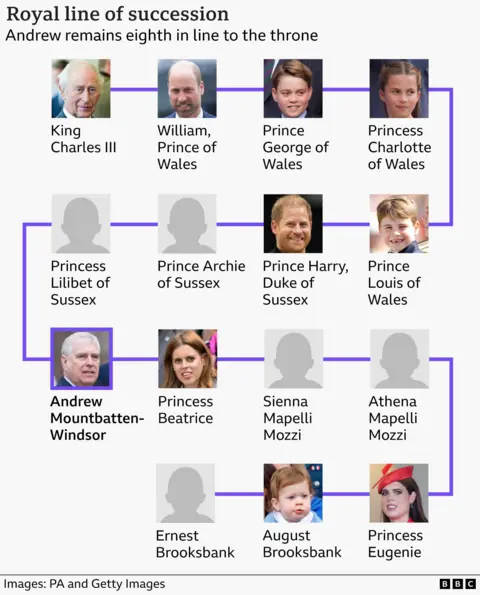
The UK government is actively considering legislation that would remove Andrew Mountbatten-Windsor, the King’s younger brother, from the line of succession, according to ministers speaking in broadcast interviews. Andrew is currently eighth in line to the throne but was stripped of his royal titles, including the style of prince and his military roles, last October following pressure over his association with convicted sex offender Jeffrey Epstein.
Defence Minister Luke Pollard said the proposed move, which would ensure Andrew could never become King, was the “right thing to do” regardless of the outcome of the ongoing police investigation. He confirmed that ministers had “absolutely” been working with the royal household on plans to stop Andrew from being “a heartbeat away from the throne,” and expressed hope for cross-party backing once the investigation concludes.
The government is considering introducing legislation to remove Andrew Mountbatten-Windsor from the line of royal succession.
Defence Minister Luke Pollard told the BBC the move – which would prevent Andrew from ever becoming King – was the “right thing to do,” regardless of the… pic.twitter.com/8VQFb2uTYX
— K24TV (@K24Tv) February 21, 2026
Andrew was arrested on suspicion of misconduct in public office and released under investigation after around 11 hours. He has consistently and strongly denied any wrongdoing. Thames Valley Police are expected to continue searching Royal Lodge, the 30-room Windsor residence where he has long lived, into Monday. Observers reported multiple unmarked vehicles entering the property over successive days.
Former senior policing adviser Danny Shaw warned the situation had “the danger of spiralling out of control,” noting that several forces across the UK are weighing whether to launch their own inquiries, which could take “considerable time.”
Politically, support for legislation has come from some smaller parties and individual lawmakers, including Liberal Democrat and Scottish National Party figures, along with Labour MP Rachael Maskell of York Central. Some other Labour parliamentarians, often critical of the monarchy, have suggested such a law may be unnecessary because it is highly unlikely Andrew would ever approach the throne under the current succession order.
Historian David Olusoga told a late-night current affairs programme there appeared to be “a desperate desire within government and within the palace to draw a firewall… between this crisis and the wider monarchy.” Buckingham Palace has not publicly commented on the possible legislation.
Julian Payne, a former communications secretary to the current King, said the monarch is able to separate “familial bonds from official duty”, adding of Andrew: “They’re very clear: this is an individual. It is not a member of the Royal Family. And they treat the two very, very differently.” He also said Queen Camilla, who spent decades as a private citizen before marrying into the institution, is “very adept at tuning into the public mood” and will likely help guide the King’s decisions.
According to research from the House of Commons Library, removing Andrew from the line of succession would also end his status as a counsellor of state, a role that allows certain senior royals to carry out official duties if the monarch is ill or overseas. In practice, recent practice has limited those stand-in functions to working royals, but the legal designation still matters.
Andrew stepped back from public duties in 2019 after a widely criticised television interview about his relationship with Epstein. The current leader of the governing Conservative Party, Kemi Badenoch, has urged that “all of us in public life need to give space” for the police investigation to proceed, underscoring that no charges have been brought and that he is entitled to the presumption of innocence.
What It Means for You
For most readers, any change to the royal line of succession will not have a direct day-to-day impact. The UK’s system of government would continue as normal regardless of one individual’s position in the order of inheritance. But as a top story in global news, it is a window into how modern institutions handle allegations involving powerful figures.
The outcome may influence how confident people feel about checks and balances around the monarchy, especially in times of crisis. It could also set a precedent for how quickly political leaders and the royal household are willing to act when a senior royal’s conduct is under investigation, even before courts have reached any conclusion.
Looking ahead, key points to watch include whether the police inquiry leads to charges or is closed with no further action, whether the government formally introduces a bill to change the succession rules, and how legislators in both houses respond. Any legislative proposal would likely spark wider debate about the future role of the monarchy, especially among younger generations and in Commonwealth countries where the British monarch remains head of state.
What do you think: should governments step in to change royal succession in situations like this, or should such decisions be left to the royal family itself?
Sources: This article is based on on-the-record remarks by UK government ministers and advisers in national broadcast interviews on 20-21 February 2026, public information from UK police forces regarding ongoing searches, and House of Commons Library briefings on succession law and counsellors of state.