Why This Matters
North Korea’s latest missile launches come just days after the UN’s nuclear watchdog warned of a “very serious” expansion in the country’s nuclear weapons capabilities. The timing links concrete military activity at sea to growing concern about what is happening inside North Korea’s nuclear facilities.
The tests also raise alarms about security in Northeast Asia, where U.S. treaty allies South Korea and Japan already face a rising number of missile launches. Each new test helps North Korea refine its arsenal, complicating defense planning and increasing the risk of miscalculation in a region dense with military assets.
Questions about whether the missiles were fired from land or a submarine add another layer of concern. A credible submarine-launch capability would make North Korea’s missiles harder to detect and intercept, and could influence upcoming diplomacy, including a planned summit between President Donald Trump and Chinese President Xi Jinping.
Key Facts and Quotes
South Korea’s Joint Chiefs of Staff said Sunday that North Korea launched multiple short-range ballistic missiles from the Sinpo area on the east coast. The missiles reportedly flew about 140 kilometers, or 87 miles, toward the country’s eastern waters. South Korea said it is maintaining readiness and sharing information closely with the United States and Japan.
Senior South Korean officials convened an emergency National Security Council meeting, expressing concern about repeated North Korean tests and urging Pyongyang to halt them. The launches took place just hours before South Korean President Lee Jae Myung departed for trips to India and Vietnam, underscoring how North Korean actions often coincide with key regional events.
The U.S. Indo-Pacific Command and Japan’s Defense Ministry both confirmed they detected the launches. Japan said it lodged a strong protest with Pyongyang, calling the tests a threat to regional and international peace and a violation of UN Security Council resolutions that ban North Korea from any ballistic missile activity.
Sinpo hosts a major North Korean shipyard used for building submarines, and South Korea’s military is analyzing whether the missiles were launched from a submarine, a land platform, or both, according to South Korean media. If confirmed as a submarine-launched ballistic missile test, it would be North Korea’s first in four years and a significant step in diversifying its launch options.
The launches follow a series of recent weapons activities. North Korea said last week that leader Kim Jong Un supervised missile tests from a destroyer, and earlier reported three days of tests involving ballistic missiles with cluster-bomb warheads and other new systems. Last month, it claimed to have tested an upgraded solid-fuel engine for missiles capable of reaching the U.S. mainland.
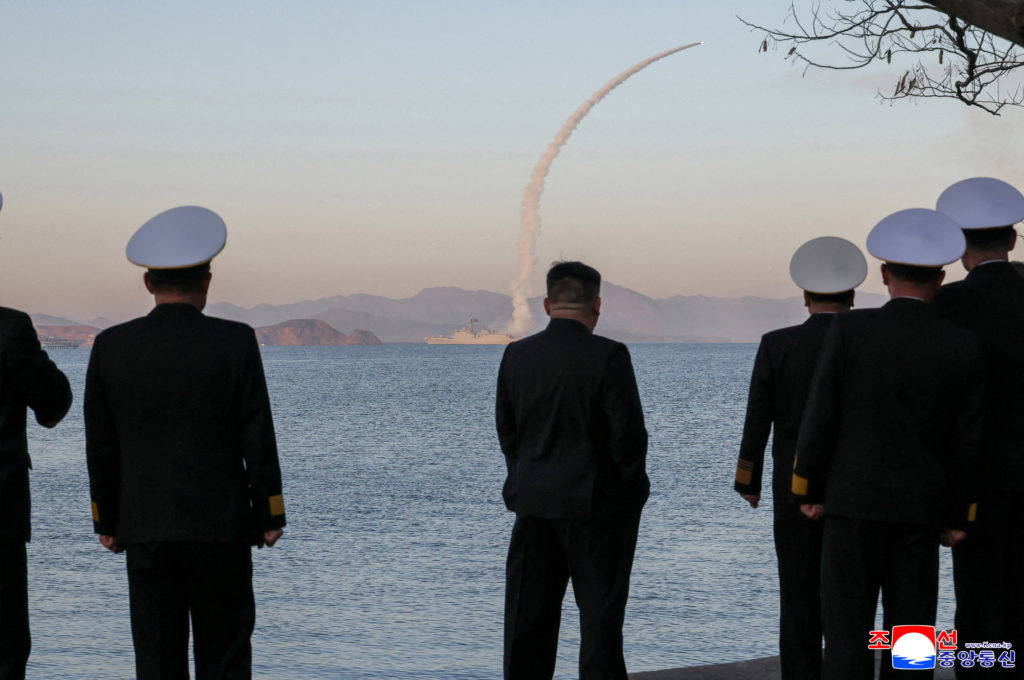
Kim has focused on expanding his nuclear and missile arsenals since high-stakes talks with President Trump collapsed in 2019. North Korea has recently signaled it could return to dialogue with Trump, but wants Washington to drop demands for full nuclear disarmament as a precondition. Some analysts believe the new tests are meant to increase North Korea’s leverage ahead of Trump’s rescheduled summit with Xi in Beijing.
On Wednesday, International Atomic Energy Agency Director General Rafael Grossi said his agency had confirmed “a rapid increase” in activity at North Korean nuclear manufacturing facilities. Speaking to reporters in Seoul, he warned the developments point to “a very serious increase” in the country’s nuclear weapons production capability and echoed outside assessments that Pyongyang has expanded its Yongbyon complex and uranium enrichment sites.
What It Means for You
For Americans and U.S. allies, the latest update underscores that North Korea’s missile and nuclear programs remain active and evolving. Even short-range launches can deepen regional tensions and strain already complex relations among Washington, Seoul, Tokyo, and Beijing.
In the weeks ahead, observers will watch for more launches, clarity on whether a submarine was involved, and any response from the UN Security Council or the IAEA. The outcome of the planned Trump-Xi summit may also shape whether this latest round of testing leads to renewed talks with North Korea or to further sanctions and military countermeasures.
How do you think regional security partners should balance military deterrence with diplomatic efforts as North Korea’s missile and nuclear capabilities continue to grow?
Sources
Associated Press report by Hyung-Jin Kim carried by PBS NewsHour on April 19, 2026; statements and briefings cited from South Korea’s Joint Chiefs of Staff and National Security Council on April 19, 2026; public comments from Japan’s Defense Ministry officials including Deputy Minister of Defense Masahisa Miyazaki in April 2026; remarks by International Atomic Energy Agency Director General Rafael Grossi to reporters in Seoul in mid-April 2026.