TL;DR
Venezuela sits on the world’s largest proven oil reserves but now pumps only a fraction of its potential output after years of political turmoil, sanctions and underinvestment.
Why This Matters
Venezuela is home to the world’s largest proven oil reserves, making it a quiet but important player in global energy markets. Even though the country currently produces relatively little crude compared with leading producers, any major change in its output can influence long-term oil supply expectations, investment decisions and geopolitical risk.
For the United States, Venezuela’s oil industry has long been tied to debates over energy security, sanctions and foreign policy in Latin America. Shifts in Washington’s approach to Caracas can affect which countries receive Venezuelan barrels, how much oil flows to world markets, and how global prices react during supply shocks elsewhere.
For Venezuelans, oil remains the backbone of the economy and government revenue. The sector’s collapse over the past two decades has deepened the country’s economic crisis and driven migration across the region. Any serious effort to rebuild production would require massive outside investment, technical support and a more predictable political and legal environment.
Key Facts & Quotes
Venezuela is a member of the Organization of the Petroleum Exporting Countries (OPEC) and holds an estimated 303 billion barrels of proven reserves, according to recent OPEC statistical data. That is roughly 17% of global proven oil reserves, giving the country a larger stated resource base than Saudi Arabia.
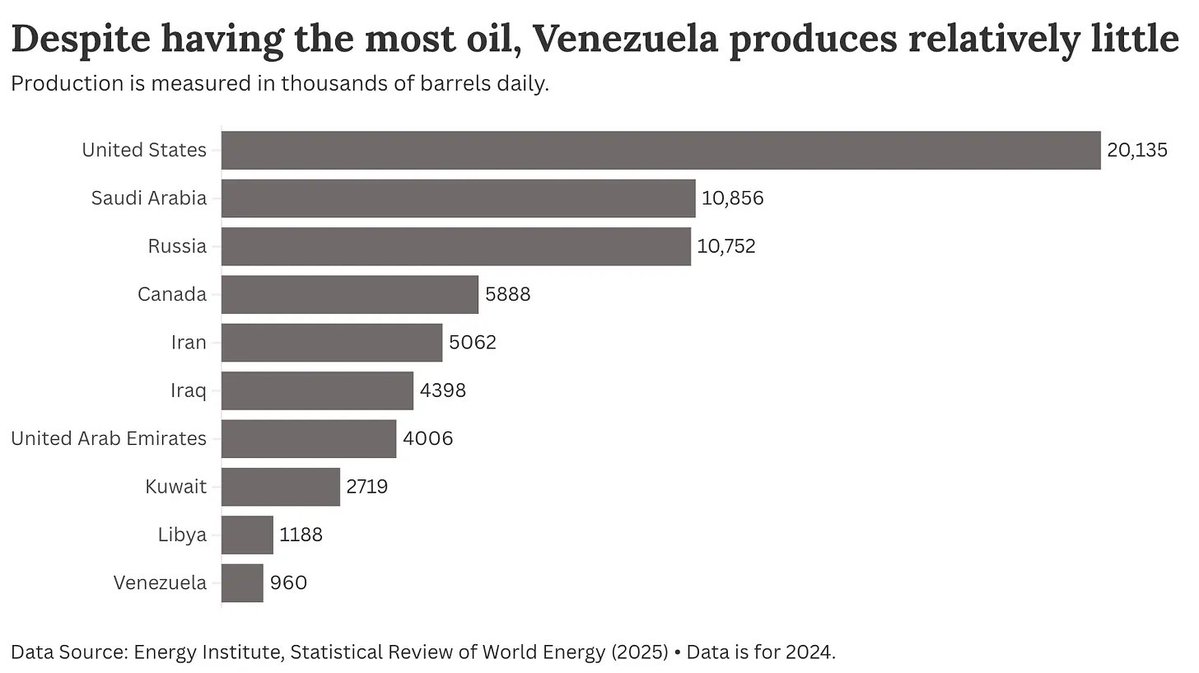
Despite this, Venezuela currently produces around 1 million barrels of crude oil per day, or well under 1% of global supply, based on recent OPEC and international energy data. In the early 2000s, the country pumped more than 3 million barrels per day, but output has fallen sharply amid years of economic mismanagement, declining investment, infrastructure problems and U.S. sanctions.
By comparison, the United States, now the world’s largest oil producer, turns out roughly 13.5 million barrels per day, according to the U.S. Energy Information Administration. Saudi Arabia produces an estimated 10 million to 12 million barrels per day, while Russia pumps close to 9 million.
Helpful context on Venezuelan oil production in @_HannahRitchie‘s excellent new post. Despite having the world’s largest oil reserves, Venezuela produces relatively little oil — and much less than in the past — when compared against other big producers. (Link next tweet) pic.twitter.com/h4Ohkyns8p
— Cardiff Garcia (@CardiffGarcia) January 5, 2026
Francisco J. Monaldi, who directs the Latin America energy program at Rice University in Texas, has estimated that a meaningful recovery in Venezuela’s oil sector would be slow and expensive. He has said it could take at least a decade and more than 100 billion dollars in investment to rebuild infrastructure and raise production toward 4 million barrels per day, which would exceed Venezuela’s historic output levels.
Analysts note that much of Venezuela’s oil is extra-heavy crude, which is harder and more costly to produce and refine. This means that technology, specialized equipment and stable long-term contracts are critical for any sustainable recovery.
What It Means for You
For everyday consumers in the United States, Venezuela’s current production levels have a limited direct impact on gasoline prices, which are more immediately driven by U.S. output, OPEC policy decisions, global demand and unexpected supply disruptions.
However, Venezuela’s vast reserves make it an important long-term factor in global energy planning. If political conditions change and sanctions ease, new Venezuelan supply over time could add to global capacity, potentially softening price spikes during future crises elsewhere.
For retirees, commuters and families watching their budgets, this story is part of the broader question of how secure and diversified global oil supplies will be in the next decade. It is also tied to the ongoing shift toward cleaner energy sources, as governments and companies weigh whether to invest billions in aging oil fields or accelerate the move to alternatives.
Sources: Organization of the Petroleum Exporting Countries (OPEC), Annual Statistical Bulletin 2023; U.S. Energy Information Administration, Short-Term Energy Outlook and international production data, 2023-2024; public remarks and analyses by Francisco J. Monaldi, Rice University Baker Institute for Public Policy.
How do you think countries should balance the use of large oil reserves like Venezuela’s with the push toward cleaner energy and climate goals?