
TL;DR
A major brain-scan study of more than 100 women suggests pregnancy trims about 5% of grey matter, likely reflecting beneficial rewiring that helps new mothers bond with and care for their babies.
Why This Matters
The new research challenges the long-standing “baby brain” cliche, which often paints pregnant women as simply forgetful or less capable. Instead, the findings point to a structured, biological reshaping of the brain as women transition into motherhood.
Grey matter is the tissue rich in nerve cells that supports thinking, emotions, and social understanding. A measurable, pregnancy-linked reduction in this tissue, centered in networks tied to empathy and self-reflection, suggests the brain may be streamlining itself for caregiving tasks.
✅🧠 Pregnant women “shed grey matter to help with motherhood,” a study seen by BBC suggests.
✅ Researchers say brain changes may support bonding and adapting to caring for a baby. #Health #Science #Pregnancy #BBC #BREAKING #BreakingNews #News pic.twitter.com/JO6eKEq4rF— Ginny Jackson (@GinnyDJcksn94) March 4, 2026
Scientists say these changes could help mothers tune in more strongly to their infants’ needs, interpret subtle cues, and form secure early bonds. Reported bonding scores in the study tended to rise in women who showed the biggest brain changes, hinting at a functional benefit rather than simple loss.
The work adds to smaller MRI studies from 2016 that also found lasting structural brain changes after pregnancy. Together, they suggest motherhood may be one of the most intense periods of adult brain plasticity, with potential implications for mental health, workplace policies, and how society talks about pregnant women’s capabilities.
Key Facts & Quotes
The latest update comes from the Be Mother project, a Spain-based research effort that followed 127 women through pregnancy using repeated MRI scans. Their brains were imaged before conception, during pregnancy, and after birth, then compared with scans from non-pregnant women.
On average, pregnant participants lost nearly 5% of grey matter volume during pregnancy, according to results published in the journal Nature Communications. One of the most affected regions was the brain’s “default mode network,” involved in empathy, self-perception, and altruistic behavior.
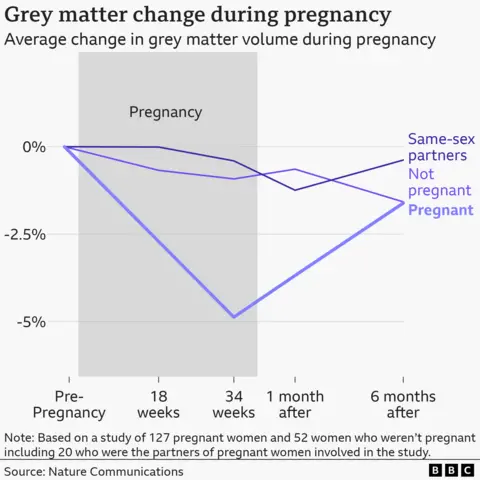
The changes did not fully reverse after birth. By six months postpartum, some grey matter had returned, but volumes remained below pre-pregnancy levels, while brain measurements in non-pregnant women stayed largely steady over the same period.

Lead investigator Prof Susana Carmona, who directs the NeuroMaternal laboratory at Madrid’s Gregorio Maranon Health Research Institute, said, “We find in biology, as in life, sometimes less is more.” She compared the process to pruning a tree so it “can grow more efficiently,” suggesting the brain may be refining circuits rather than simply losing capacity.
Participant Tania Esparza, now a new mother, rejected the idea that pregnancy makes women less competent. “Rather than becoming dumber, we are becoming more specialised for the job,” she said, welcoming evidence that frames the changes as adaptation instead of decline.
The study was not designed to directly test memory lapses often called baby brain, but it confirms that pregnancy brings marked structural changes. An earlier European MRI study in 2016 found similar grey matter reductions lasting at least two years after childbirth, reinforcing the view that these shifts are robust and long-lasting.
What It Means for You
For expectant parents, the findings offer a different way to understand mental changes during pregnancy. Occasional forgetfulness or feeling “foggy” may coexist with gains in other areas, such as reading a baby’s signals, emotional attunement, and rapid learning of new caregiving skills.
Researchers stress that a 5% drop in grey matter does not mean reduced intelligence. Instead, the brain appears to be reallocating resources, a form of plasticity similar to changes seen when people learn complex new tasks.
Looking ahead, scientists say more work is needed to see how these changes relate to postpartum depression, anxiety, and stress, and whether support during pregnancy can influence long-term brain and mental health. For families, employers, and policymakers, the study raises questions about how best to support women at a time when their brains and lives are undergoing intense, biologically driven change.
How, if at all, has pregnancy or early parenthood changed the way you think about your own mind and capabilities?