Why This Matters
A high-profile Blue Origin launch on Sunday successfully reused and recovered a powerful New Glenn booster, but the rocket’s upper stage left a next-generation cellphone satellite in the wrong orbit, rendering it unusable. The mixed result underscores both the promise and fragility of today’s commercial space industry.
The satellite, AST SpaceMobile’s BlueBird 7, was designed to test and expand direct-to-cellphone broadband service from space. Misplacing it in orbit delays part of that effort and raises questions about the reliability of a launch system that aims to compete for multibillion-dollar government and commercial contracts.
The incident also comes as companies race to build large constellations of low-Earth-orbit satellites for internet and mobile coverage worldwide. Any setback to a major launch provider can ripple through schedules, insurance costs, and customer confidence across the sector.
Key Facts and Quotes
Blue Origin launched its third New Glenn rocket from Cape Canaveral Space Force Station in Florida at 7:25 a.m. Eastern on Sunday, company officials said. The mission carried BlueBird 7, a direct-to-cellphone communications satellite built by AST SpaceMobile of Midland, Texas. It was the first New Glenn flight to use a previously flown first stage.
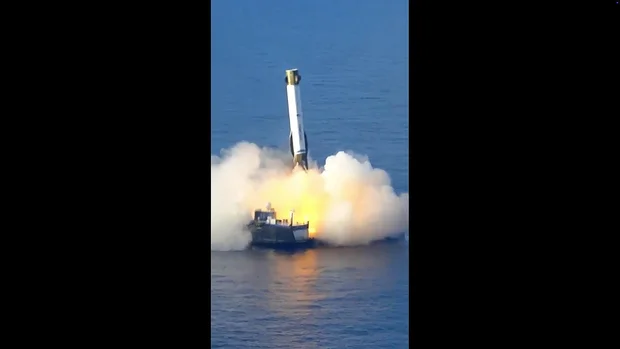
The seven-engine first stage performed as planned, separating about three minutes after liftoff and then flying itself to a landing on a company barge in the Atlantic Ocean roughly nine minutes into the mission. Blue Origin had refurbished the booster and installed a new set of engines. In an earlier post, CEO Dave Limp said the company replaced all seven engines and tested upgrades, noting that engines from a prior New Glenn flight would be reused on future missions.
Attention then shifted to the upper stage, powered by two BE-3 engines. After reaching initial orbit, it was expected to fire again about an hour and 10 minutes after launch. That second burn did not unfold as anticipated. Blue Origin later said on social media that payload separation was confirmed and that the AST satellite had powered on, but acknowledged it was in an ‘off-nominal orbit’ and that teams were assessing the situation.
AST SpaceMobile said in a statement that BlueBird 7 was placed into a lower-than-planned orbit by the rocket’s upper stage. The company said the on-board propulsion system cannot compensate for the lower altitude, which is too low to sustain long-term operations, and that the satellite will deorbit. The cost of the spacecraft was not disclosed, but AST SpaceMobile said it was fully insured.
BlueBird 7 carries a roughly 2,400-square-foot phased array antenna, which the company describes as the largest civilian antenna of its kind ever flown in low-Earth orbit. It is the second in a new generation of satellites meant to deliver 4G and 5G broadband service directly to standard cellphones without ground-based towers. AST SpaceMobile has said it plans to launch up to 60 of these “Block Two” BlueBird satellites on multiple rockets and still targets about 45 in orbit by the end of 2026 despite Sunday’s mishap.
Blue Origin, owned by Amazon founder Jeff Bezos, has positioned New Glenn to compete to launch commercial, military, and science payloads and to support Amazon’s planned low-Earth-orbit internet constellation. How quickly the company identifies and fixes the cause of the off-target orbit will likely influence future contracts and launch timelines.
What It Means for You
For consumers, the most immediate impact is on the timeline for space-based cellphone coverage, a service that aims to provide connectivity in remote areas, disaster zones, and at sea. AST SpaceMobile still expects a steady launch cadence, but the loss of a key satellite highlights how technical setbacks can slow ambitious communications projects.
For taxpayers and investors, the outcome is a reminder that large rockets and satellite constellations remain high-risk, high-cost ventures, even as reusability improves economics. In the coming months, watch for Blue Origin’s investigation results, potential schedule changes for New Glenn launches, and how satellite operators diversify their launch options to manage risk.
How much risk and delay are you personally willing to accept in exchange for global, space-based cellphone coverage that works far from today’s networks?
Sources
CBS News report by William Harwood, April 19, 2026; statements from AST SpaceMobile regarding the BlueBird 7 mission, April 2026; public posts and launch updates from Blue Origin and CEO Dave Limp, April 2026.