TL;DR
The Supreme Court will hear Trump v. Slaughter, a dispute over firing an FTC commissioner that could roll back long-standing limits on presidential control of independent agencies.
Why This Matters
The case reaches far beyond one commissioner or one administration. At its core is a basic question in the U.S. government: how much control should a president have over regulators that are designed to stand apart from day-to-day politics?
Independent agencies such as the Federal Trade Commission, the Securities and Exchange Commission, and others oversee markets, consumer protection and parts of the financial system. For nearly 90 years, a 1935 Supreme Court ruling known as Humphrey’s Executor has allowed Congress to give their leaders extra job protection, making them harder for presidents to fire.
If the justices now say those protections violate the separation of powers, future presidents could remove commissioners at will. That could quickly change the direction of antitrust enforcement, consumer watchdog work and oversight of major industries, depending on who is in the White House.
The case also fits into a broader trend: in recent years, the Court has been more skeptical of the “administrative state,” limiting the power and structure of federal agencies in several high-profile decisions. Trump v. Slaughter is the latest and potentially most sweeping test of that shift.
Key Facts & Quotes
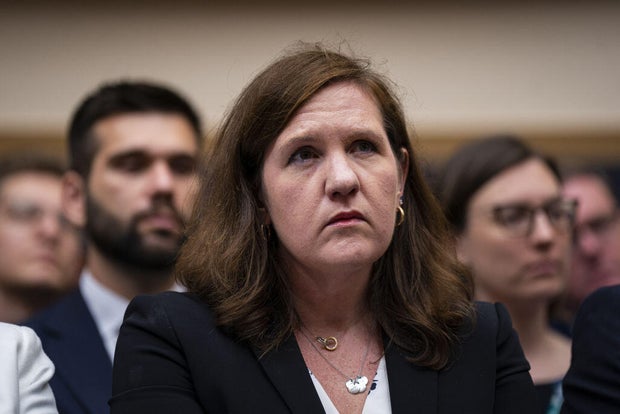
The dispute began when President Donald Trump, in his second term, sought to remove Rebecca Kelly Slaughter, a Democratic commissioner at the Federal Trade Commission, from her post without alleging misconduct. According to court filings and news reports published on Dec. 5, the move ran up against a federal law that says commissioners may be removed only for “inefficiency, neglect of duty or malfeasance in office.”
That language reflects the Supreme Court’s 1935 Humphrey’s Executor decision, which upheld limits on a president’s power to fire members of independent commissions like the FTC. The Court at the time accepted that Congress could insulate such officials to promote expert, nonpartisan oversight.
In Trump v. Slaughter, the justices are being asked to decide whether those removal limits now violate the Constitution’s separation of powers and whether Humphrey’s Executor should be overturned. The argument, scheduled for Monday, comes after a series of recent rulings that weakened similar protections.
NEW: Our legal team and 39 other groups just submitted an amicus brief in support of reinstating FTC Commissioner Slaughter, who Trump attempted to fire illegally. We call on the Supreme Court to stand up for independent federal agencies and consumers! https://t.co/iOsAyiyuGG pic.twitter.com/b6eVFeCDaR
— Food & Water Watch (@foodandwater) December 5, 2025
In 2020, the Court in Seila Law LLC v. Consumer Financial Protection Bureau struck down job protections for the CFPB’s single director. A year later, in Collins v. Yellen, it reached a similar conclusion about the Federal Housing Finance Agency. Taken together, those rulings narrowed Humphrey’s Executor and opened the door to the broader challenge now before the Court.
What It Means for You
For most people, the case will not change anything overnight. But over time, the ruling could affect how strongly the federal government polices issues like deceptive advertising, data privacy, mergers, and pricing practices in major industries.
If the Court gives presidents wider firing power, independent agencies may become more closely aligned with the policy priorities of each administration, potentially leading to sharper swings in regulation after elections. If the Court keeps current protections, the system of buffered, longer-term oversight will largely remain in place.
Either way, Trump v. Slaughter is a key “what it means” story to watch for retirees, working families, and business owners who rely on stable rules of the road in the marketplace.
Sources: National U.S. broadcast news report on Trump v. Slaughter, Dec. 5, 2025; U.S. Supreme Court opinions in Humphrey’s Executor v. United States (1935), Seila Law LLC v. Consumer Financial Protection Bureau (June 29, 2020), and Collins v. Yellen (June 23, 2021).
What do you think: how much independence should federal watchdogs have from whoever holds the presidency?