TL;DR
The Pentagon and Energy Department airlifted a 5-megawatt, privately built microreactor from California to Utah, marking the first U.S. military flight of a small reactor. The unfueled unit is central to former President Donald Trump’s effort to rapidly expand nuclear power for artificial intelligence data centers and military bases, while critics warn that safety and waste plans remain unclear.
Why This Matters
This latest update sits at the intersection of energy policy, national security, and technology. Rising demand from artificial intelligence and data centers is straining electric grids, and many officials see nuclear power as a carbon-free way to add round-the-clock electricity without relying more on fossil fuels.
Microreactors, which are small and designed to be portable, could change how power is delivered to remote locations or military installations. Supporters say they could keep critical operations running even if the civilian grid is disrupted. The Feb. 15 flight also reflects a broader push by the Trump administration to accelerate nuclear projects by shifting some approval authority from the long-standing Nuclear Regulatory Commission to the Energy Department.
At the same time, nuclear safety experts and environmental groups question whether new designs can be deployed quickly without cutting corners on oversight. They point to unresolved issues around accident risks, transport security, and long-term waste disposal. How those questions are answered will shape whether microreactors become a major part of the U.S. power mix or remain a niche technology.
Key Facts & Quotes
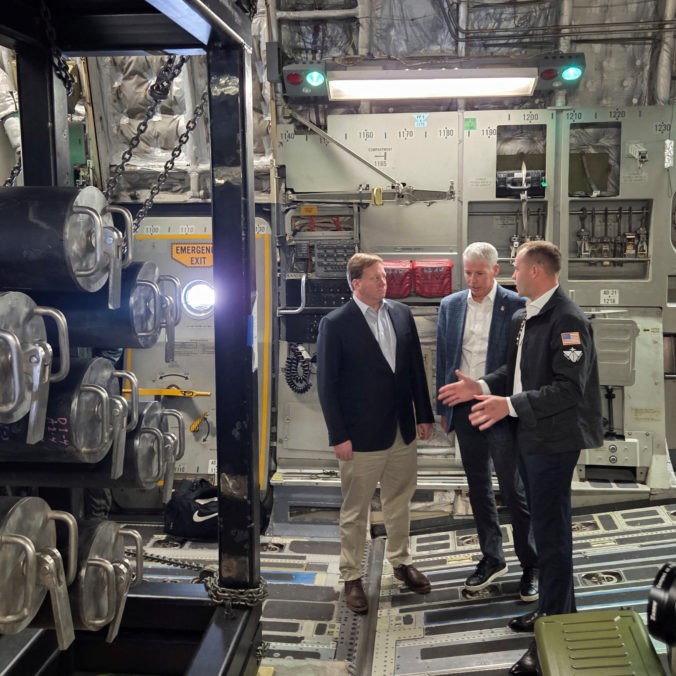
According to U.S. defense and energy officials, the airlift moved a 5-megawatt microreactor from March Air Reserve Base in California to Hill Air Force Base in Utah, a nearly 700-mile flight on a C-17 military aircraft. The unit, roughly the size of a minivan and flown without nuclear fuel, was built by Valar Atomics, a California startup.
Energy Secretary Chris Wright and Michael Duffey, the Under Secretary of Defense for Acquisition and Sustainment, traveled with the reactor. Wright called the mission a milestone in efforts to speed commercial licensing of microreactors under a series of Trump executive orders that gave the Energy Department more authority over some advanced designs.
“Today is history. A multi-megawatt, next-generation nuclear power plant is loaded in the C-17 behind us,” Wright said before takeoff, adding that several microreactors are expected to reach “criticality” by July 4, as Trump has promised. “That’s speed, that’s innovation, that’s the start of a nuclear renaissance,” he said.
Duffey said microreactors could eventually supply secure electricity to military bases independent of the civilian grid, arguing the demonstration “gets us closer to deploy nuclear power when and where it is needed to give our nation’s warfighters the tools to win in battle.” The reactor can generate up to 5 megawatts, enough to power about 5,000 homes, Valar Atomics CEO Isaiah Taylor said. It is headed to the Utah San Rafael Energy Lab for testing, with fuel to be provided by the Nevada National Security Site.
The U.S. currently has 94 operating commercial reactors providing about 19% of the nation’s electricity, down from 104 in 2013, according to the U.S. Energy Information Administration. That backdrop has driven interest in smaller, more flexible designs such as microreactors and small modular reactors.
Not all experts are convinced. Edwin Lyman, director of nuclear power safety at the Union of Concerned Scientists, described the high-profile flight as “a dog-and-pony show” that “doesn’t answer any questions about whether the project is feasible, economic, workable, or safe – for the military and the public.” He said the administration “hasn’t made the safety case” for transporting fueled microreactors or managing their waste.
Wright said the Energy Department is in talks with Utah and other states about potential sites to reprocess fuel or host permanent disposal facilities. “The answer to energy is always more,” he said, adding that after earlier limits on some energy sources, “Now we’re trying to set everything free. And nuclear will be flying soon.”
What It Means for You
For most people, this story is a signal of where U.S. energy policy may be heading rather than an immediate change at the power outlet. If microreactors move from testing to broad deployment, they could eventually support data centers, military facilities, and remote communities, potentially affecting how reliable the grid feels during extreme weather or high demand.
The debate also matters for taxpayers and nearby communities. Decisions about siting test facilities, hosting long-term waste storage, or expanding nuclear capacity often involve local governments and public input. As the Utah tests proceed and federal regulators weigh next steps, residents in affected states may see new hearings, environmental reviews, and job opportunities linked to nuclear projects.
In the near term, the key things to watch are safety evaluations at the Utah San Rafael Energy Lab, any changes in licensing rules for advanced reactors, and how states respond to federal proposals on fuel reprocessing and waste disposal.
Question for readers: Do you think small, portable reactors should play a major role in meeting America’s growing energy needs, or should the focus stay on other sources like renewables and large plants?
Sources: Statements and briefings from U.S. Energy Department and Pentagon officials on the Feb. 15, 2026, microreactor flight; remarks by Energy Secretary Chris Wright, Under Secretary of Defense Michael Duffey, Valar Atomics CEO Isaiah Taylor, and Edwin Lyman of the Union of Concerned Scientists; data from the U.S. Energy Information Administration.