TL;DR
Japan’s and South Korea’s leaders shared a surprise K-pop drum duet in Nara, using music and personal chemistry to signal warmer ties and closer cooperation.
Why This Matters
The drum duet between Japanese Prime Minister Sanae Takaichi and South Korean President Lee Jae-myung was more than a light moment at the end of a summit. It came against a backdrop of decades of mistrust rooted in Japan’s colonial rule of the Korean Peninsula, disputes over wartime forced labor and territorial claims, and periodic trade tensions.
Both governments have tried in recent years to stabilize relations, helped by shared security concerns over North Korea’s missile and nuclear programs and China’s growing influence in East Asia. The United States, which maintains large military bases in both countries, has encouraged closer coordination among the three allies.
Public displays of warmth between leaders can make it easier to sell cooperation at home, where historic grievances still run deep. A relaxed cultural exchange, especially one shared widely on social media, may help humanize political figures and soften public skepticism. While a drum performance cannot resolve long-standing disputes, it signals a willingness to engage, communicate and keep diplomatic channels open at a sensitive moment for regional security.
Key Facts & Quotes
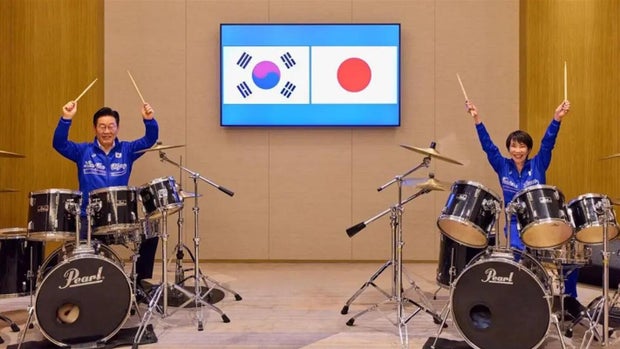
The performance took place Tuesday in Nara, Japan’s ancient capital and Takaichi’s hometown, after a bilateral summit. Video posted on the official Instagram account of the Japanese Prime Minister’s Office showed Takaichi and Lee in matching athletic jackets, seated side by side at drum kits.
Prime Minister Sanae Takaichi on the drums, alongside President Lee Jae-myung of South Korea 🇯🇵🤝🇰🇷 https://t.co/2H8u268gsP pic.twitter.com/QwQ7iDC4Sk
— さんきち👍✨ (@sankichi48) January 13, 2026
The two leaders played along to K-pop hits, including BTS’s “Dynamite” and “Golden” by K-pop Demon Hunters. According to the Japanese side, the jam session was arranged as a surprise after Lee mentioned at a previous international meeting that learning drums was a personal dream.
“Playing the drums has been my longtime dream,” Lee wrote on X, thanking Takaichi for organizing the session. Reflecting on the symbolism, he added that, “Like we respected our differences and harmonized our rhythms, I hope that Korea and Japan would deepen cooperation and move closer to each other step by step,” acknowledging his own performance was “a little clumsy.”
Takaichi, known domestically as a conservative politician and a longtime heavy metal fan who drummed in college, praised Lee as a quick learner for picking up the rhythm in minutes. On X, she linked the moment directly to policy, saying that to advance relations “in a forward-looking way and stably, we will continue our close communication” and pursue active “shuttle diplomacy” between Seoul and Tokyo.
Early reaction on social media in both countries was largely positive, with some users saying the sight of the two leaders genuinely enjoying themselves made them more hopeful about the future of Japan-South Korea ties.
What It Means for You
For many readers, this story sits at the intersection of global news, culture and security. Japan and South Korea are key economic partners for the United States and central to Washington’s strategy in the Indo-Pacific. Their cooperation influences supply chains for cars, electronics and advanced technology, as well as joint responses to crises involving North Korea or tensions around Taiwan.
Moments like this drum duet do not change policy overnight, but they can make it easier for leaders to sustain dialogue on harder issues, from defense coordination to trade. If relations continue to improve, Americans could see more aligned positions among the three countries on sanctions, military exercises and high-tech exports. The next indicators to watch will be follow-up summits, concrete security agreements and whether both governments can manage domestic criticism while keeping this warmer tone alive.
Sources: Official Instagram reel from the Prime Minister’s Office of Japan (posted January 15, 2026); public posts on X by Lee Jae-myung and Sanae Takaichi (January 14-15, 2026); contemporaneous English-language broadcast report published January 14, 2026.
Question for readers: Do informal cultural moments like this between leaders make you more optimistic about long-term relations between their countries, or do you see them mainly as symbolic gestures?