Why This Matters
NASA’s Artemis II mission is designed to send four astronauts around the moon and back, marking the first crewed lunar voyage since the Apollo era. Any delay in its launch reverberates well beyond a single rocket test. It affects the broader Artemis program, which aims to return humans to the lunar surface and eventually support a sustained presence there.
The latest fueling test, or “wet dress rehearsal,” for the Space Launch System (SLS) moon rocket was supposed to clear the way for an early February launch window, including a highly anticipated Super Bowl Sunday liftoff. Instead, a recurring liquid hydrogen leak has again raised technical and schedule questions. Hydrogen, while efficient as a rocket fuel, is notoriously difficult to contain, especially in the complex plumbing at the launch pad.
For taxpayers and space-watchers, these issues highlight the trade-off between speed and safety in human spaceflight. Each delay adds cost and pushes back future missions, including planned lunar landings and, longer term, ambitions for Mars. At the same time, NASA officials emphasize that catching problems on the ground, rather than in flight, is a central part of responsible testing.
Key Facts & Quotes
During an overnight wet dress rehearsal at Kennedy Space Center, NASA fully loaded the SLS core stage with more than 750,000 gallons of supercooled liquid oxygen and liquid hydrogen, according to agency updates cited in a CBS News report on Feb. 3, 2026. The test followed earlier workarounds for a hydrogen leak detected during initial fueling.
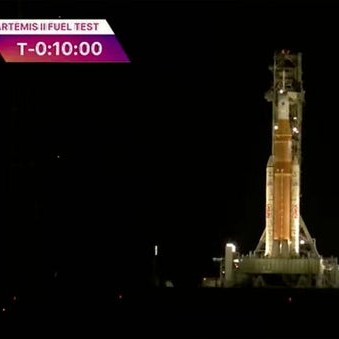
The countdown, already several hours behind schedule, resumed at the T-minus 10-minute mark around 12:09 a.m. EST Tuesday. Four and a half minutes later, controllers halted the clock again after another liquid hydrogen leak was detected at the interface of the tail service mast umbilical, a structure at the base of the rocket that houses key fuel lines.
“The launch control team is working to ensure the SLS rocket is in a safe configuration and begin draining its tanks,” NASA said in a social media update early Tuesday. In a blog post referenced by CBS News, the agency added that teams will review the data and conduct a second wet dress rehearsal, shifting the earliest possible launch opportunity to March.
Hydrogen Leak Delays NASA’s Artemis II Moon Mission.
NASA’s #ArtemisII , the mission to send astronauts farther than ever around the Moon, has been delayed to March after a hydrogen leak during a practice launch. The 10-day flight will test life support, navigation, and… pic.twitter.com/64mxpef8HH— AE News (@aenewsEnglish24) February 3, 2026
Moving off the February window means the Artemis II crew commander, Reid Wiseman, pilot Victor Glover, mission specialist Christina Koch, and Canadian astronaut Jeremy Hansen will temporarily leave quarantine in Houston. They had been targeting a roughly nine-day flight around the moon, with potential launch dates on Feb. 8, 10, or 11. A Super Bowl Sunday launch now appears unlikely, though managers will decide next steps after data reviews and a planned briefing.
The SLS, a 332-foot-tall rocket capable of generating 8.8 million pounds of thrust at liftoff, previously flew only once, on the uncrewed Artemis I mission in 2022. That campaign also faced hydrogen leaks and pad plumbing issues. Launch Director Charlie Blackwell-Thompson said last week that lessons from Artemis I, including changes in how liquid oxygen and hydrogen are loaded, were intended to make Artemis II fueling smoother. “Artemis I was the test flight, and we learned a lot during that campaign,” she said. Despite upgrades, leakage at the tail service mast umbilical, a known trouble spot from 2022, resurfaced in the latest test.
What It Means for You
For many in the United States, Artemis II is more than a technical milestone. It is a high-visibility symbol of American space leadership and international cooperation, with a Canadian astronaut on board. The latest delay means a longer wait to see live coverage of astronauts traveling around the moon for the first time in more than 50 years.
In practical terms, the slip to March at the earliest does not change everyday life, but it does shape when the public will see the next big step toward future lunar landings. A cautious pace now could reduce risks to crew and hardware later, potentially preventing more serious setbacks. In the weeks ahead, watch for NASA’s detailed findings from the leak investigation, any hardware repairs or design changes at the tail service mast, and a revised launch schedule. Those decisions will influence the timeline not only for Artemis II, but also for future missions that aim to land astronauts on the moon’s surface.
Join the Conversation
How should NASA balance schedule pressure with safety and thorough testing as it prepares to send astronauts back toward the moon?
Sources: NASA public updates and social media statements, Feb. 3, 2026; CBS News space coverage of Artemis II wet dress rehearsal, Feb. 3, 2026.