TL;DR
President Volodymyr Zelensky has outlined a revised 20-point peace plan that could see Ukrainian troops pull back in parts of eastern Donetsk to create demilitarised or free economic zones, with U.S.-backed security guarantees if Russia attacks again.
Why This Matters
The latest update on Ukraine’s peace framework comes after nearly four years of full-scale war, with heavy losses on both sides and deep economic damage far beyond Eastern Europe. Any shift toward demilitarised zones in Donbas would mark a significant change from Kyiv’s long-held refusal to consider troop withdrawals on its own territory.
The plan also highlights how central Washington remains to any settlement. U.S. envoys have been shuttling between Ukrainian, European and Russian representatives, seeking a formula that offers Moscow an off-ramp while preserving Ukraine’s sovereignty and future security. According to a detailed account from a major UK public broadcaster, the new blueprint links military pullbacks to firm security guarantees from the United States, NATO and European partners.
Beyond the battlefield, the proposal folds in long-term economic and political goals: a large Western-backed investment fund, a clearer path toward European Union membership and early elections once a deal is signed. Together, these elements underscore that any eventual agreement will not only stop the fighting, but also shape Ukraine’s place in Europe and the global economy for decades.
Key Facts & Quotes
According to the updated plan described by Zelensky to reporters in Kyiv, U.S. and Ukrainian negotiators in Florida agreed on a 20-point framework that now goes back to Moscow via Washington. Russian officials are expected to respond after consultations with U.S. representatives.
The plan is presented as the main structure for ending the war. It includes:
- Security guarantees from the U.S., NATO and European states, pledging a coordinated military response if Russia invades again.
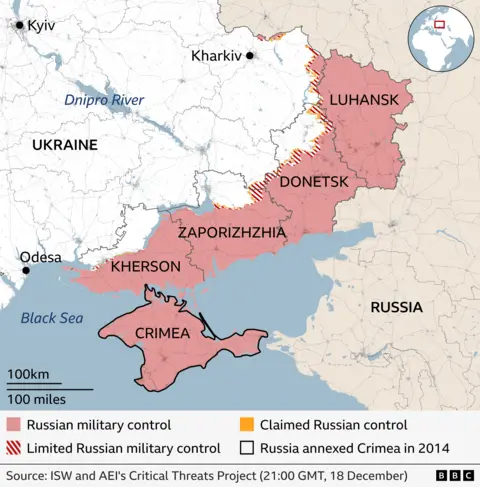
- A potential pullback of Ukrainian heavy forces by 5-40 km in the roughly 25% of Donetsk region Kyiv still controls, creating an almost demilitarised or free economic zone.
- A matching withdrawal of Russian forces on the other side of the line.
- A target Ukrainian force level of about 800,000 troops under the new security architecture.
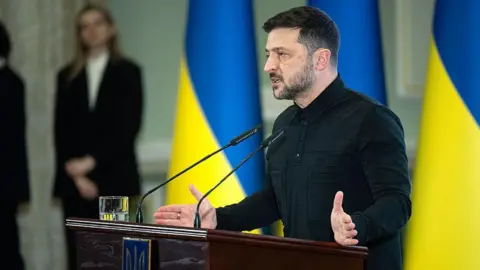
On Donbas, Zelensky said there were only two paths: “There are two options, either the war continues, or something will have to be decided regarding all potential economic zones.” He stressed that any free economic zone in Donetsk would remain under Ukrainian administration and police, “definitely not the so-called Russian police.” International forces would patrol the contact line to prevent infiltration.
Zelensky outlines a new peace plan for Ukraine, exploring demilitarised zones and the concept of a “free economic zone” in Donbas.
➡️ https://t.co/FU9f18CQoK pic.twitter.com/yQzudsVCrE— H24 News UK (@h24news_uk) December 24, 2025
The 20-point text revises an earlier 28-point draft negotiated by U.S. envoy Steve Witkoff with Russian counterparts, which Ukrainian officials viewed as tilted toward Moscow. Sensitive territorial issues, Zelensky said, would ultimately require decisions by national leaders and a Ukrainian referendum on the overall package and any special economic arrangements in Donbas.
The framework notably omits any ban on Ukraine joining NATO, a key Russian demand in previous talks, and envisions Ukraine joining the European Union on a defined timetable. It also sketches a roughly $200 billion Western-backed investment fund and calls for elections in Ukraine as soon as possible after a deal, despite the current state of martial law.
Russian President Vladimir Putin has publicly vowed to take all of eastern Ukraine by force if Kyiv does not pull out, while Russia has dismissed earlier European ideas for international peacekeeping as a “brazen” threat. At the same time, U.S. President Donald Trump’s team is pressing for a settlement. Zelensky told journalists that Moscow “cannot tell President Trump, look we’re against a peaceful settlement,” warning that if Russia blocked talks, Washington would have to increase arms supplies and tighten sanctions.
What It Means for You
For readers in the United States and Europe, this latest update is a reminder that the war in Ukraine remains closely tied to Western security, energy prices and public budgets. A durable peace deal could ease pressure on defense spending, help stabilize global food and fuel markets, and reduce the risk of a wider confrontation between Russia and NATO.
The details also matter for long-term stability. Demilitarised or free economic zones can freeze front lines, as seen on the Korean Peninsula, but they can also harden divisions if not backed by strong international monitoring and political agreements. The proposed security guarantees, investment fund and EU track for Ukraine point toward a long-term Western commitment that taxpayers and voters may be asked to support.
As talks move forward, key issues to watch include whether Russia accepts any form of international presence on the ground, how far Ukraine is willing to adjust its military positions and what kind of binding guarantees Western governments are prepared to sign. How do you think the balance should be struck between ending the fighting quickly and securing a lasting, enforceable peace?