Why This Matters
The sale of a Titanic survivor’s life jacket for more than 900,000 dollars highlights how objects from historic disasters continue to command extraordinary prices. For many buyers and museums, these artifacts are seen as powerful, physical links to human stories that might otherwise fade.
The auction also reflects a broader market for memorabilia tied to major turning points in modern history, from wars and political upheavals to transportation disasters. As fewer living witnesses remain, collectors are paying more to secure items that document those events.
At the same time, the sale raises ongoing questions about where items from tragedies belong. Some argue they should remain in public museums, while others see private collectors as partners in preservation. The high-profile Titanic market sits at the center of that debate.
Key Facts and Quotes
Henry Aldridge and Son, an auction house in Devizes in western England, sold the life jacket on Saturday for 906,000 dollars to an unnamed bidder participating by telephone, according to the auctioneer. The price far exceeded the presale estimate of roughly 250,000 to 350,000 pounds.
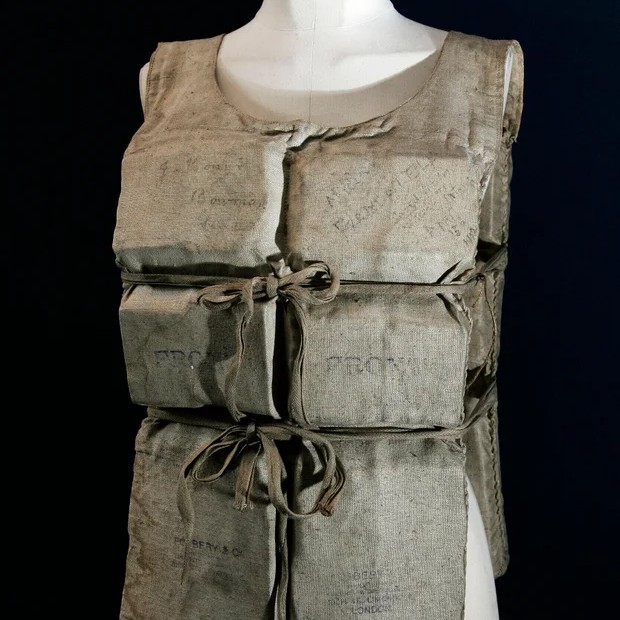
The cream-colored jacket, made of canvas with cork sections for flotation, was worn by first-class passenger Laura Mabel Francatelli as she escaped the sinking ship in a lifeboat. It bears her signature and those of other survivors from the same boat, and has previously been displayed in museums in the United States and Europe.
Auctioneer Andrew Aldridge said there are only a small number of survivor-worn Titanic life jackets known to exist, and most are held by museums that are unlikely to sell. He said the record sums show the continuing interest in the Titanic story and the respect paid to passengers and crew whose experiences are represented by such items.
The sale also included other items from the liner, such as a seat cushion from one of the lifeboats. That cushion sold for 527,000 dollars to the owners of two Titanic museums in Pigeon Forge, Tennessee, and Branson, Missouri. Auction officials said the reported prices include the buyer’s premium, the fee added to the winning bid.
The Titanic, promoted in its day as the world’s most luxurious ocean liner and widely described as virtually unsinkable, struck an iceberg off Newfoundland during its maiden voyage from England to New York. It went down in the early hours of April 15, 1912, and about 1,500 of the roughly 2,200 people on board died.
Francatelli traveled with her employer, fashion designer Lucy Duff Gordon, and Gordon’s husband, Cosmo. All three survived aboard lifeboat number 1, which was launched with only 12 people despite space for 40, a detail that drew criticism because so many others were left in the freezing water. Survivors from underfilled boats, including theirs, were later rescued by the ship Carpathia.
Interest in Titanic items has remained strong. In 2025, a collector paid more than 2 million dollars for an 18-carat gold pocket watch that once belonged to American businessman Isidor Straus, a co-owner of Macy’s, who died with his wife, Ida, on the sinking. According to biographical notes held by the United Kingdom’s National Archives, the couple was known for giving up lifeboat seats so younger people could escape.
What It Means for You
For readers in the United States, sales like this help explain why Titanic-related exhibits continue to expand, including at dedicated museums in states such as Tennessee and Missouri. High auction prices can make it more likely that rare artifacts will end up on display, but they can also push some pieces into private collections.
Looking ahead, major anniversaries of the sinking and any discoveries at the wreck site are likely to bring more items to market and keep the debate alive over how to balance historic preservation, public access, and private ownership of objects tied to tragic events.
How do you think artifacts from historic tragedies should be handled: kept only in public museums, or shared between public institutions and private collectors?
Sources
CBS News report based on Associated Press material, April 18, 2026; public statements and sale notes from Henry Aldridge and Son auctioneers, April 2026; United Kingdom National Archives biographical notes on Isidor and Ida Straus cited in prior reporting.